

Andy Warhol Exhibition in Landerneau

Nearly twenty years after the last major French retrospective devoted to Andy Warhol, the Fonds Hélène & Édouard Leclerc pour la Culture (FHEL) in Landerneau is presenting, from 6 June 2026 to 24 January 2027, an exhibition that has already established itself as one of the year's major artistic events. The result of an unprecedented partnership with The Andy Warhol Museum in Pittsburgh, the artist's hometown, the exhibition brings together nearly 200 works—paintings, screenprints, drawings, photographs, films, objects, archives, and documents—offering an exceptional overview of more than four decades of artistic creation.
The exhibition goes far beyond a simple gathering of Pop Art's most iconic images. Curated by Amber Morgan, Director of Collections and Exhibitions at The Andy Warhol Museum, its ambition is to reveal the full richness of an artist whose worldwide fame has sometimes obscured the complexity of his work. While visitors naturally come to admire the Campbell's Soup Cans, the portraits of Marilyn Monroe, and the celebrated Dollar Signs, the exhibition above all seeks to introduce a more intimate, intellectually sophisticated, and nuanced Warhol than the familiar image of the "painter of soup cans." Visitors follow the evolution of Andrew Warhola, a young commercial illustrator who arrived in New York in the late 1940s, into Andy Warhol, one of the defining figures of the international art scene, whose influence continues to shape contemporary art, fashion, photography, cinema, and popular culture today.

The Andy Warhol Museum: An Exceptional Partnership
Opened in 1994, The Andy Warhol Museum is today the world's largest institution dedicated to a single artist. Its collections include more than 13,000 works, along with hundreds of thousands of photographs, films, letters, notebooks, personal archives, and objects that once belonged to Warhol. These treasures rarely leave the United States, making their presentation in Landerneau a remarkable event made possible only after several years of discussions between the American museum and the Fonds Hélène & Édouard Leclerc.
The exhibition follows both a chronological and thematic approach. From the very first galleries, visitors discover Warhol's commercial drawings from the 1950s. Long before becoming one of the leading figures of Pop Art, Warhol enjoyed a brilliant career as a commercial illustrator. He worked for America's leading fashion magazines, created campaigns for shoe manufacturers, cosmetics brands, and luxury accessories, and developed the elegant, repetitive, instantly recognizable graphic language that would later become his artistic signature. Rarely exhibited in France, these drawings demonstrate that Pop Art did not emerge through a radical break, but rather as the continuation of Warhol's close observation of the commercial world and printed imagery.
This early period is illustrated by several shoe drawings as well as the celebrated advertising posters created for Halston, the fashion designer who became one of Warhol's closest collaborators during the 1970s. Also included in the exhibition, these advertising works remind visitors that Warhol never truly separated artistic creation from commercial communication. For him, an advertising campaign could achieve the same visual power as a museum masterpiece, provided it succeeded in embedding itself permanently in the collective imagination.
The exhibition then leads visitors into the 1960s, the decade during which Warhol permanently transformed the history of art. Everyday objects became the central subjects of his paintings. Campbell's Soup cans, Coca-Cola bottles, dollar bills, food packaging, and household products were reproduced through screen printing with a deliberate emotional detachment that stood in sharp contrast to the dominant Abstract Expressionism of the time. The exhibition reminds visitors that Warhol did not choose these subjects merely to provoke; rather, he saw them as the true visual landscape of modern America. A Coca-Cola bottle or a soup can is seen daily by millions of people, making them, in his eyes, the new icons of contemporary society.
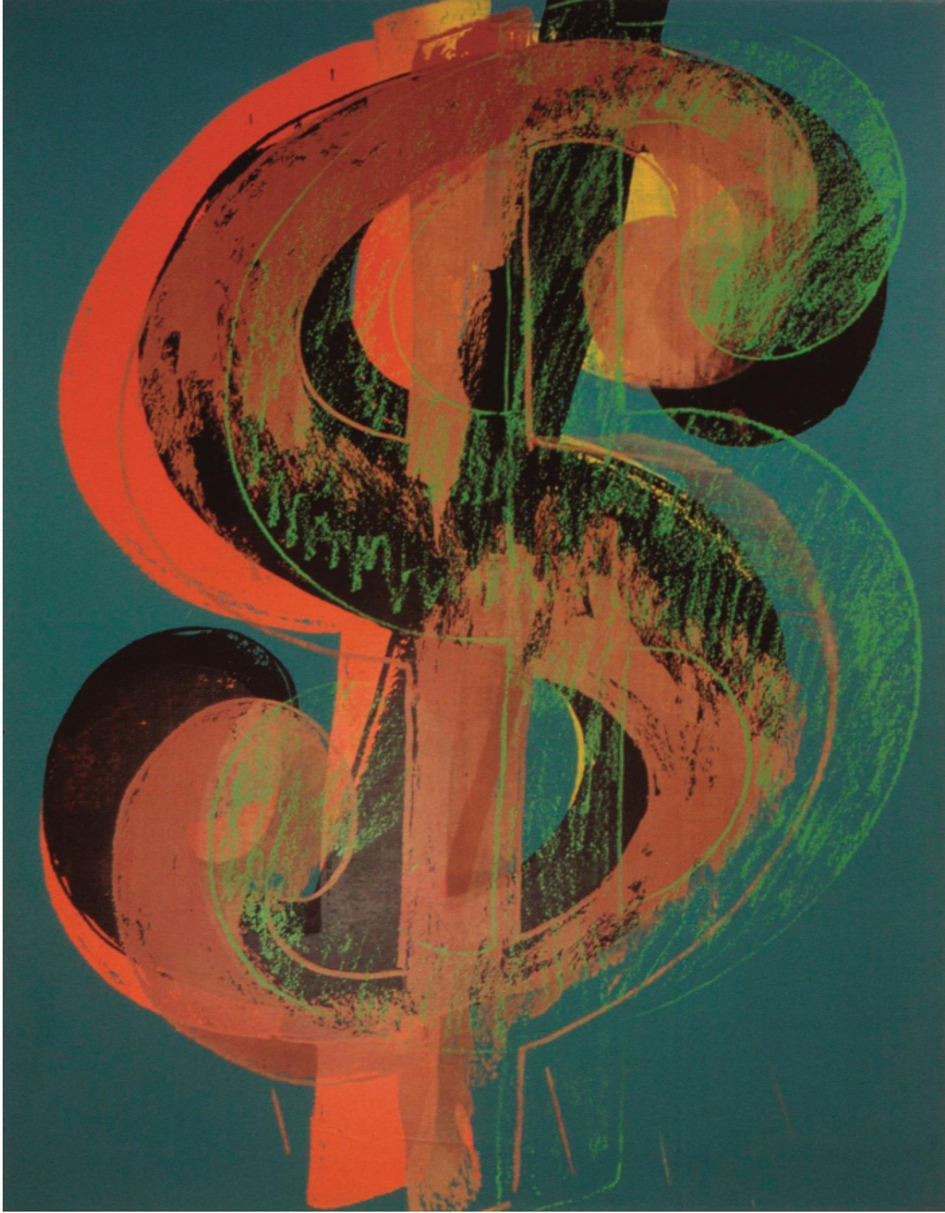
Among the exhibition's highlights is Dollar Sign (1981), a monumental canvas that immediately captures visitors' attention at the heart of the exhibition. This series marked Warhol's return to a more gestural style of painting in the early 1980s. The iconic dollar symbol is treated simultaneously as a graphic sign, an advertising image, and an autonomous pictorial subject. Broad, colourful brushstrokes merge with screen printing in a composition of remarkable vitality. The work perfectly encapsulates Warhol's ambiguous relationship with money, where fascination, irony, celebration, and critical distance coexist without ever settling into a single definitive interpretation.
Another spectacular work, Diamond Dust Shoes (1980), recalls Warhol's beginnings as a fashion illustrator. Several elegant shoes appear to float against a deep black background, while their surfaces are coated with industrial glass powder—the famous Diamond Dust—creating a shimmering effect under the gallery lights. The work represents one of Warhol's finest syntheses of luxury and industrial reproduction, two defining aspects of his artistic practice. Through an apparently ordinary subject, Warhol demonstrates how everyday objects can become desirable, almost sacred images once they are elevated to the status of cultural icons.
The exhibition also features several works from the Ads series, produced in 1985. Here, Warhol reinterprets famous American advertising campaigns as works of art. Slogans, logos, and commercial imagery become vibrant compositions in which the distinction between popular culture and fine art completely disappears. Among these works is The New Spirit, inspired by one of America's most famous advertising campaigns, as well as a striking portrait of Ronald Reagan, treated using the same graphic techniques that Warhol had previously applied to movie stars and musicians since the 1960s. This deliberate parallel between advertising, politics, and celebrity remains one of the defining themes of his entire body of work.
Far from focusing exclusively on Warhol's best-known images, the exhibition also devotes considerable space to preparatory drawings, photographs, experimental films, and the extensive archives preserved in Pittsburgh. These materials offer invaluable insight into the daily workings of The Factory, the legendary studio where artists, musicians, models, writers, collectors, and celebrities came together. Visitors discover an extraordinarily methodical Warhol, who collected everything, archived every document, and meticulously recorded conversations, appointments, and everyday objects with almost obsessive precision. This documentary dimension sheds new light on an artist too often reduced to his most famous screen prints.

Michel-Édouard Leclerc and the FHEL: A Cultural Vision Beyond the Major Cities
The Andy Warhol exhibition in Landerneau is not merely an exceptional artistic event; it is also the culmination of a cultural project initiated more than fifteen years ago by Michel-Édouard Leclerc. By founding the Fonds Hélène & Édouard Leclerc pour la Culture (FHEL) in 2012, within the former Capuchin convent in Landerneau, the president of the E.Leclerc retail group did not intend to create a traditional museum. Instead, his ambition was to establish a venue capable of hosting major international exhibitions in a medium-sized town, far from Europe's major cultural capitals. At the time, the idea seemed bold. Yet in just over a decade, the FHEL has become one of France's most dynamic cultural institutions, welcoming more than one million visitors while earning the trust of some of the world's leading museums.
This credibility was not built overnight. In his interview with La Gazette Drouot published on the occasion of the Warhol exhibition, Michel-Édouard Leclerc explains that when the project was first launched, the Foundation owned no permanent collection. Unlike many museums, it could not rely on an existing body of works to organise exhibitions. Every project therefore required convincing collectors, lenders, and foreign institutions to entrust masterpieces that often rank among the most valuable pieces in their collections. According to Leclerc, this confidence was gradually earned through the professionalism of the Foundation's team, the quality of its previous exhibitions, and the reputation it has built over the years among major international institutions.
The history of the Warhol exhibition perfectly illustrates this approach. Michel-Édouard Leclerc recalls that it took several years of meetings and discussions with the leadership of The Andy Warhol Museum in Pittsburgh before the project could finally become a reality.
This close relationship with the artworks is also reflected in the decision to entrust the curatorship to Amber Morgan, curator at The Andy Warhol Museum. Her approach deliberately departs from spectacular exhibitions focused solely on the artist's most famous images. Here, visitors certainly encounter Pop Art's iconic masterpieces, but they also discover rarely exhibited commercial drawings, archives, photographs, advertising posters, works on paper, and documentary material that place each creation within its historical context. Rather than presenting a succession of masterpieces, the exhibition offers a comprehensive understanding of Warhol's artistic development.
This desire to tell a coherent story rather than simply assemble prestigious works perfectly reflects the philosophy of the Fonds Hélène & Édouard Leclerc. Since its opening, every major exhibition organised in Landerneau has sought to offer a fresh perspective on a significant artist. Joan Miró, Pablo Picasso, Alberto Giacometti, Marc Chagall, Jean Dubuffet, Enki Bilal, Ernest Pignon-Ernest, and Henry Moore have all been the subject of ambitious exhibitions, many developed in collaboration with the artists' foundations or estates.
This commitment to accessibility is also reflected in the choice of Landerneau itself. Establishing an institution of this scale in the heart of Brittany might once have seemed paradoxical at a time when major international exhibitions were largely concentrated in Paris, London, or New York. Yet the success of the FHEL demonstrates that there is a genuine audience for contemporary art well beyond the world's major metropolitan centres. Every new exhibition attracts visitors from across Brittany, throughout France, and increasingly from abroad. Over the years, Landerneau has established itself as a cultural destination in its own right, capable of welcoming hundreds of thousands of visitors around demanding and ambitious artistic projects.
The Warhol exhibition also resonates with Michel-Édouard Leclerc's own personal history. During his interview, he recalls the links between his family's story and some of the themes central to Warhol's work. His father, Édouard Leclerc, was among the first French retailers to sell Coca-Cola in his Landerneau store. At first glance, this anecdote might suggest an attempt to draw a direct parallel between Pop Art and the history of modern retailing. Michel-Édouard Leclerc firmly rejects such an interpretation. In his view, Warhol was never simply depicting consumer products; rather, he was fascinated by the way everyday objects become universal symbols, instantly recognisable across every social class and every culture. What interested Warhol was not the Coca-Cola bottle itself, but its extraordinary ability to transcend social and cultural boundaries.
This interpretation closely aligns with the view now widely shared by art historians. Long portrayed as a critic of consumer society, Andy Warhol is increasingly understood as a far more ambiguous observer. He never openly condemned the modern world; instead, he simply presented its images, repetitions, methods of dissemination, and remarkable power of fascination. Campbell's Soup cans, Coca-Cola bottles, dollar bills, and celebrity portraits were not selected to denounce mass consumption, but because they had become the new icons of American civilisation. It is precisely this refusal to impose a moral judgement that explains why Warhol's work remains so strikingly relevant today.
Across Europe, Warhol continues to be one of the most frequently exhibited artists. Institutions such as Tate Modern in London, Museum Ludwig in Cologne, Museum Brandhorst in Munich, MUMOK in Vienna, and the Whitney Museum of American Art in New York continue to explore the many dimensions of his work through both permanent collections and thematic exhibitions. In recent years, several major exhibitions have also focused on his work as a filmmaker, his collaborations with Jean-Michel Basquiat, and his lasting influence on contemporary artists.
The Landerneau exhibition, however, occupies a unique place within this international landscape. Through its remarkable scale, the exceptional quality of the loans granted by The Andy Warhol Museum, and its deliberate ambition to present a complete portrait of the artist, it stands as one of the most significant European Warhol exhibitions of recent years. It also confirms the prominent position now held by the Fonds Hélène & Édouard Leclerc, which has established itself among the institutions capable of conceiving and presenting exhibitions of true international calibre, well beyond the circle of France's major national museums.

Andy Warhol: A Life Devoted to Transforming Everyday Images into Art
Born Andrew Warhola on 6 August 1928 in Pittsburgh, Pennsylvania, Andy Warhol was the fourth child of a family of immigrants from what is now Slovakia. His father, a construction worker, died when Andrew was only thirteen years old. His mother, Julia Warhola, played a decisive role in shaping his artistic vocation. An amateur illustrator herself, she encouraged her son to draw during the long periods of illness that marked his childhood. Suffering from Sydenham's chorea, the young Andrew spent weeks confined to bed, where he developed a fascination with illustrated magazines, Hollywood stars, comic books, and advertisements. This visual universe, omnipresent in post-war America, would later become the foundation of his entire artistic practice.
After studying at the Carnegie Institute of Technology in Pittsburgh—now Carnegie Mellon University—Warhol moved to New York in 1949 with the ambition of becoming a commercial illustrator. His talent was quickly recognised by America's leading fashion magazines. Vogue, Harper's Bazaar, Glamour, and The New Yorker regularly commissioned his drawings, while prestigious brands including I. Miller Shoes and Tiffany & Co. hired him to create advertising campaigns. Even at this early stage of his career, Warhol developed an aesthetic based on repetition, simplified forms, and instantly recognisable imagery. Unlike many artists of his generation, he did not seek to distance himself from commercial culture; on the contrary, he embraced it as his primary field of artistic experimentation.
The true turning point came in the early 1960s. At the time, Abstract Expressionism still dominated the American art scene. Painters such as Jackson Pollock, Willem de Kooning, and Mark Rothko embodied an expressive and deeply subjective approach to painting. Warhol took the opposite direction. Rather than expressing personal emotions, he chose to depict the most ordinary objects of everyday life: Campbell's Soup cans, Coca-Cola bottles, dollar bills, Brillo soap pad boxes, and portraits of celebrities reproduced from press photographs. By using screen printing, an industrial technique that allowed images to be endlessly reproduced, he deliberately erased the visible trace of the artist's hand and challenged the very notion of the unique work of art. This radical approach established him as one of the leading figures of Pop Art, alongside Roy Lichtenstein, Claes Oldenburg, James Rosenquist, and Robert Rauschenberg.
The year 1962 marked Warhol's definitive entry into the history of art with the exhibition of Campbell's Soup Cans at the Ferus Gallery in Los Angeles. The thirty-two canvases, each depicting a different variety of Campbell's soup, bewildered critics while captivating the public. Warhol explained that he had eaten Campbell's soup almost every day for years; his choice was not intended as provocation. He simply wanted to demonstrate that the most ordinary consumer products had become the true symbols of American society. Only a few months later, he created his celebrated portraits of Marilyn Monroe, Elvis Presley, Elizabeth Taylor, and Jacqueline Kennedy, images that remain among the most iconic works in twentieth-century art.
Beginning in 1963, Warhol established his studio in a vast New York loft that soon became known as The Factory. Far more than a simple artist's workshop, The Factory evolved into a cultural laboratory where painters, musicians, writers, models, collectors, and celebrities gathered. Lou Reed and The Velvet Underground recorded their earliest albums there under Warhol's artistic direction, while personalities such as Edie Sedgwick, Nico, Dennis Hopper, Jean-Michel Basquiat, Keith Haring, and Truman Capote became regular visitors to this now legendary space. Warhol also developed an intense interest in filmmaking. Films such as Sleep, Empire, Chelsea Girls, and Screen Tests pushed the boundaries of experimental cinema and reflected his fascination with duration, observation, and repetition.
In 1968, Warhol's life changed dramatically when writer Valerie Solanas shot him inside The Factory. Gravely wounded, he narrowly survived but suffered lasting physical consequences for the rest of his life. The attack marked a profound turning point in both his life and career. During the following years, Warhol became more discreet and increasingly focused on commissioned portraits and collaborations with influential figures from the worlds of business, politics, and culture. Although this evolution was once interpreted as a retreat from his earlier artistic audacity, art historians now see it as another facet of his enduring investigation into fame and power. Applying the same visual language to corporate executives, American presidents, and major collectors, Warhol continued to explore the mechanisms through which images shape contemporary society.
The 1980s witnessed a remarkable renewal of Warhol's artistic language. Series such as Shadows, Oxidation Paintings, Rorschach, Camouflage, Dollar Sign, and Ads testify to an artist whose creativity remained undiminished. He also collaborated extensively with a younger generation of artists, notably Jean-Michel Basquiat, Francesco Clemente, and Keith Haring. Long regarded as secondary within his career, these late works are now recognised as among the most innovative chapters of his artistic legacy.
Andy Warhol died in New York on 22 February 1987, following complications after gallbladder surgery. He left behind an extraordinary body of work comprising thousands of paintings, screen prints, drawings, photographs, films, sound recordings, books, and archives, making him one of the most thoroughly documented artists of the twentieth century. His influence extends far beyond the boundaries of Pop Art. Artists such as Jeff Koons, Takashi Murakami, Damien Hirst, Richard Prince, KAWS, Shepard Fairey, and Banksy have all acknowledged, to varying degrees, the profound impact of Warhol's reflections on images, media, and popular culture.
On today's art market, Andy Warhol remains one of the world's most sought-after artists. Every year, thousands of his works change hands through public auctions and private sales. His portraits of Marilyn Monroe, Mao Zedong, and Elizabeth Taylor regularly rank among the highest-priced works of contemporary art, with several achieving prices well in excess of 100 million dollars. This sustained demand confirms that Warhol's work is far more than a testament to the 1960s; it continues to occupy a central place in the world's leading public and private collections.
The Landerneau exhibition therefore assumes a particular significance. Beyond the prestige of the exceptional loans granted by The Andy Warhol Museum in Pittsburgh, it reminds visitors that Warhol cannot be reduced to a handful of colourful screen prints or the myths surrounding his personality. The man who famously declared that "everyone will be world-famous for fifteen minutes" now appears as an extraordinarily perceptive observer who anticipated the mechanisms of today's image-driven society long before the emergence of the internet, social media, and digital communication.
This is undoubtedly the greatest achievement of the retrospective. By bringing together nearly 200 works spanning the artist's entire career, the Fonds Hélène & Édouard Leclerc offers far more than an exhibition devoted to the Pope of Pop Art. It invites visitors to rediscover a creator whose reflections on consumer culture, celebrity, image reproduction, and the power of the media have never felt more relevant. Thanks to the exceptional quality of the loans, the richness of the exhibition conceived by Amber Morgan, and Michel-Édouard Leclerc's commitment to making culture accessible to all, Andy Warhol in Landerneau stands as one of the landmark exhibitions of 2026 and an unmissable destination for anyone wishing to understand one of the most influential artists in the history of contemporary art.


Comments