

Robert Indiana: A $102 Million Judgment to Protect the Legacy of the Creator of LOVE

Updated: Sep 1
In April 2026, a federal jury in Manhattan ordered the American art publisher American Image Art LLC and its president, Michael McKenzie, to pay $102.2 million in damages to the Morgan Art Foundation (MAF), Robert Indiana's longtime partner. The verdict brought to a close one of the most significant recent legal disputes involving the estate of a contemporary artist. Filed in 2018, the lawsuit concerned the production and sale of unauthorized works attributed to Robert Indiana between 2016 and 2018, as well as breaches of contract and violations of intellectual property rights. Given both its financial magnitude and legal significance, the judgment sets an important precedent for artists' estates and the protection of copyright within the art market.
A Case Filed Before the Artist's Death
The dispute officially began in May 2018, when the Morgan Art Foundation filed a lawsuit in the U.S. District Court for the Southern District of New York. The day after the complaint was filed, Robert Indiana died at the age of 89 at his home in Vinalhaven, Maine. The litigation subsequently continued in order to protect his artistic legacy and intellectual property rights. According to the foundation, several individuals close to the artist took advantage of his declining health during the final years of his life, between 2016 and 2018, by producing and selling works without complying with the existing agreements between Robert Indiana and the Morgan Art Foundation.

The Role of the Morgan Art Foundation
The Morgan Art Foundation has maintained a professional relationship with Robert Indiana since the early 1990s. The organization manages a significant portion of the reproduction rights, commercial licensing, and international exploitation of some of his most iconic works, particularly the LOVE series. Over the decades, this collaboration resulted in numerous agreements covering editions, monumental sculptures, prints, and a variety of publishing and exhibition projects. The foundation argued that the activities of American Image Art directly infringed upon these agreements and undermined the integrity of Robert Indiana's artistic legacy.
The Foundation's Allegations
According to the complaint, Michael McKenzie and American Image Art orchestrated the production of thousands of works presented as authentic creations by Robert Indiana over several years, particularly LOVE sculptures. The foundation alleged that these works were produced without valid authorization and in breach of the contractual agreements previously established with the artist. The artworks were then allegedly marketed and sold to galleries, dealers, and collectors in the United States and abroad. The Morgan Art Foundation further claimed that certain signatures, approvals, and authorizations had been obtained while Robert Indiana was in a severely deteriorated state of health, significantly impairing his ability to understand and control decisions made on his behalf.
Jamie Thomas at the Center of the Artist's Final Years
The case also involved Jamie Thomas, Robert Indiana's former assistant and caregiver. Initially hired to assist the artist with everyday tasks, Thomas gradually assumed a much broader role in managing his personal affairs. According to evidence presented during the trial, he was granted a power of attorney beginning in 2016, allowing him to make certain administrative and commercial decisions on the artist's behalf. The Morgan Art Foundation argued that this arrangement facilitated agreements that were contrary to Robert Indiana's interests and incompatible with his existing contractual commitments. Jamie Thomas has consistently denied these allegations.
The Defense's Position
Michael McKenzie and American Image Art denied all allegations brought against them. They maintained that they had worked with Robert Indiana with his full knowledge and consent, arguing that the disputed works were produced with the artist's authorization. The defendants also contended that the Morgan Art Foundation was asserting intellectual property rights that extended far beyond those actually granted under the parties' agreements. In 2022, American Image Art filed a separate lawsuit challenging the foundation's claimed intellectual property rights. That action was dismissed by the federal court in 2024, strengthening the Morgan Art Foundation's legal position ahead of the main trial.

The Trial
The trial opened before a federal jury in Manhattan in the spring of 2026. Over the course of several weeks, jurors examined historic contracts, correspondence, commercial licensing agreements, expert opinions, testimony from individuals close to Robert Indiana, and numerous documents relating to the production and sale of the disputed works. The proceedings focused primarily on the validity of the authorizations claimed by American Image Art, Robert Indiana's capacity to provide informed consent during the final years of his life, and the scope of the rights held by the Morgan Art Foundation.
A $102.2 Million Judgment
On April 23, 2026, the federal jury found American Image Art and Michael McKenzie liable for multiple civil violations, including tortious interference with existing contracts, infringement of intellectual property rights, and the unauthorized commercial exploitation of Robert Indiana's works. The Morgan Art Foundation was awarded $102.2 million in damages, making it one of the largest financial judgments ever issued in litigation involving the legacy of an American contemporary artist.
A Permanent Injunction
In addition to the financial award, the federal court issued a permanent injunction prohibiting American Image Art and Michael McKenzie from producing, reproducing, or marketing certain Robert Indiana works without the authorization of the Morgan Art Foundation. The injunction primarily concerns works incorporating the artist's most iconic compositions, particularly those derived from the LOVE series. Its purpose is to prevent any further distribution of works deemed unauthorized and to safeguard the integrity of Robert Indiana's official catalogue.
The Impact on the Art Market
The ruling underscores the critical importance of provenance and documentation in the contemporary art market. Collectors, galleries, and auction houses are now paying even closer attention to the origin of artworks, certificates of authenticity, and licensing agreements. For owners of Robert Indiana works, the judgment reinforces the value of pieces with impeccable provenance. The disputed works are those produced during the final two years of the artist's life, beginning in 2016. Conversely, works originating from the contested distribution channels may face greater scrutiny and increased challenges on the secondary market.
The judgment against American Image Art does not automatically render every artwork sold by the company legally invalid or without value. However, it creates significant uncertainty regarding the authenticity, commercial legitimacy, and future marketability of those works, particularly in the secondary market.

A Legal Landmark
The Robert Indiana case has now become an important reference in the field of art law. It confirms that contracts entered into during an artist's lifetime remain enforceable after their death and demonstrates that U.S. courts are willing to award substantial damages when violations of intellectual property rights and harm to the integrity of the art market are established. The case may influence future disputes involving artists' estates whose works continue to generate significant revenue through licensing, editions, and reproductions.
New York's Iconic LOVE Sculpture Is Not Affected by the Case
In practice, New York's famous LOVE sculpture is not affected by this litigation.
It is important to distinguish between the historic monumental sculptures created decades earlier and the works and editions produced during the final years of Robert Indiana's life, between 2016 and 2018, which are at the heart of the dispute.
The LOVE sculpture installed in New York (currently located at the corner of Sixth Avenue and 55th Street) is an authorized monumental version of the work originally created in the 1970s. It belongs to the category of historic sculptures whose authenticity has never been questioned. The first LOVE sculptures were produced as early as 1970, long before the disputes between the Morgan Art Foundation and American Image Art arose.
Biography of Robert Indiana
Born Robert Clark on September 13, 1928, in New Castle, Indiana, Robert Indiana was one of the leading figures of American Pop Art. He spent his childhood in modest circumstances, marked by his family's frequent relocations during the Great Depression. After serving in the U.S. Army from 1949 to 1953, he used the G.I. Bill to pursue artistic studies at the Art Institute of Chicago, the Edinburgh College of Art in Scotland, and the Skowhegan School of Painting and Sculpture in Maine. In 1954, he moved to New York, then at the center of a thriving artistic scene, where he adopted the name Robert Indiana in tribute to his home state.
During the 1960s, he developed an instantly recognizable visual language based on numbers, words, bold colors, and references to American culture. His works drew inspiration from road signs, commercial advertising, and national symbols. Unlike many other Pop artists, whose work focused primarily on consumer society, Robert Indiana created an artistic universe in which words themselves became the central subject. Themes such as love, hope, patriotism, spirituality, and American identity occupied a prominent place throughout his career.
His international breakthrough came in 1965 with the creation of LOVE, a typographic composition in which the four letters are arranged in a square with the "O" tilted diagonally. The image became an immediate success. The Museum of Modern Art in New York first used it for a holiday greeting card before it was reproduced as posters, monumental sculptures, and, in 1973, on a U.S. postage stamp issued in more than 300 million copies. LOVE quickly became one of the most recognizable images in the history of contemporary art, establishing Robert Indiana as an internationally celebrated artist.
Beyond LOVE, Indiana produced several major series devoted to numbers, stars, American symbols, and words. Works such as The American Dream, The Electric Eat, The Hartley Elegies, and HOPE reflect his enduring interest in language and in the social, political, and cultural tensions of the United States. After leaving New York in the late 1970s, he settled permanently on the island of Vinalhaven, Maine, where he continued his artistic practice while leading a relatively private life.
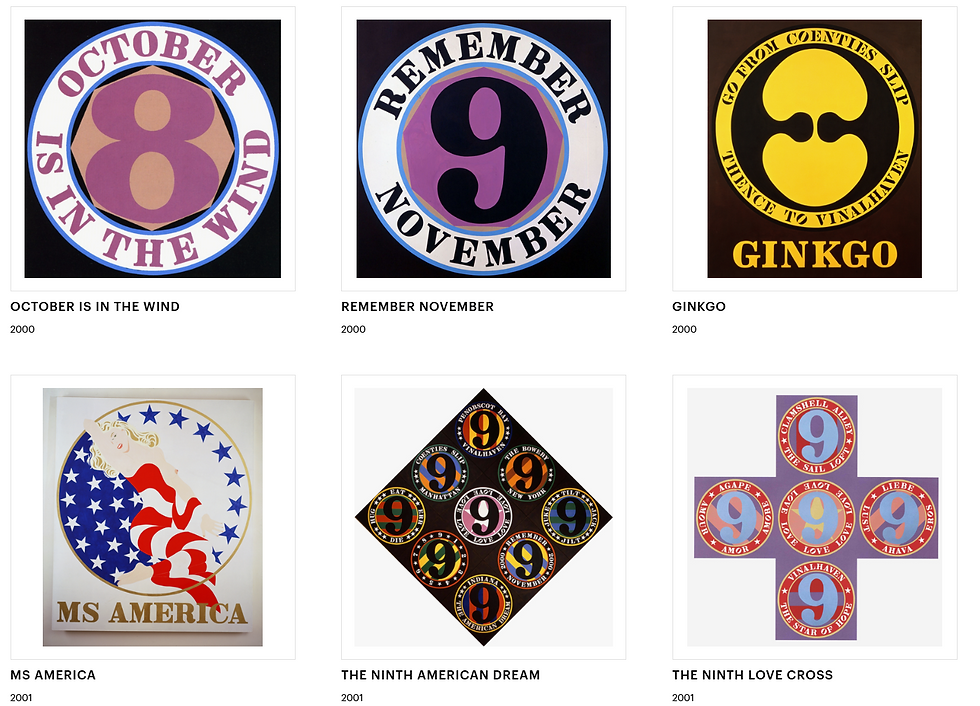
His works are now held in the collections of many of the world's leading museums, including the Museum of Modern Art, the Whitney Museum of American Art, the National Gallery of Art in Washington, the Tate Modern in London, and the San Francisco Museum of Modern Art. Monumental LOVE sculptures have been installed in cities around the globe, including New York, Philadelphia, Tokyo, Singapore, Taipei, Jerusalem, Doha, and Madrid, making the work one of the most recognizable public artworks of the twentieth century.
The market for Robert Indiana's work remains particularly active. His monumental sculptures regularly achieve several million dollars at public auction, while his historic paintings from the 1960s rank among the most sought-after works of American Pop Art. LOVE prints also continue to enjoy strong demand, supported by the worldwide recognition of the image and its enduring international appeal. Robert Indiana passed away on May 19, 2018, in Vinalhaven, Maine, leaving behind a body of work that has become a universal symbol of postwar American art. Today, his legacy is protected by a particularly vigilant estate, as demonstrated by the landmark lawsuit that resulted in the 2026 judgment ordering American Image Art to pay more than $102 million in damages.
What Impact Will the Ruling Have on Robert Indiana's Market?
In the short term, the court's decision is widely viewed as a stabilizing factor for the Robert Indiana market. By bringing several years of uncertainty to an end regarding the production and sale of works created between 2016 and 2018, during the final years of the artist's life, the verdict is expected to strengthen confidence among collectors and art market professionals. The market for Robert Indiana's work has long been structured around a clear hierarchy, with historic paintings from the 1960s, monumental sculptures, authorized editions, and licensed reproductions occupying distinct positions. The legal clarification provided by the court is likely to further enhance the value of works with impeccable provenance and complete documentation. Pieces held in major museum collections, monumental sculptures produced with the artist's authorization, and early works originating from established galleries are expected to remain the most desirable segment of the market. Conversely, works produced during the final years of Robert Indiana's life will likely be subject to increased scrutiny by auction houses, experts, and collectors. This heightened level of due diligence could reduce the market liquidity of certain pieces whose provenance is incomplete or whose production history remains disputed.
The Importance of Provenance and Authentication
The Robert Indiana case highlights the growing importance of provenance in the contemporary art market. The artistic quality of a work alone is no longer sufficient to guarantee its value. Its ownership history, the agreements authorizing its production, certificates of authenticity, and the artist's archival records have become equally essential factors. In the case of Robert Indiana, collectors increasingly favor works with a fully documented chain of ownership, whether paintings, sculptures, drawings, or prints. Before acquiring a work, professionals recommend carefully verifying its provenance, successive invoices, certificates of authenticity, any inclusion in a catalogue raisonné, and the information available from the official representatives of the artist's estate or rights holders. This growing emphasis on traceability, already crucial for major twentieth-century artists, is expected to become even more significant following this landmark case. Beyond Robert Indiana himself, the judgment serves as a reminder that the legal security of an artwork has become just as important as its rarity, condition, or aesthetic quality.


Comments